
TelQ Platform
View our MNP map to see which countries support mobile number portability and when they adopted it. Test your SMS routes to ported numbers quickly and reliably with TelQ!

Our mobile portability map provides a detailed look at the countries that have implemented MNP services, allowing users to retain their numbers when switching providers. Hover over any country on the map to view the specific year it introduced MNP. The color shading indicates when MNP was adopted: darker colors represent earlier adoption years, while lighter colors show more recent implementations.
Use these MNP data as a quick reference to support your SMS routing strategies and make sure your messages reach ported numbers.
Last updated: May 2026 — 4 new countries added, coverage now at 119 countries.

Older
Newer
No MNP
Here is a detailed table listing all countries with MNP adoption dates. The table is easy to navigate, featuring options to sort by year or country name and a search bar for quick access to specific entries.
Use this tool to assess MNP implementation timelines and understand market readiness, helping you make strategic decisions on SMS routing, ported number verification, and adapting services to fit various countries’ MNP maturity levels.
| Country | Year MNP was launched |
|---|---|
| United Kingdom | 1999 |
| Netherlands | 1999 |
| Hong Kong | 1999 |
| Spain | 2000 |
| Switzerland | 2000 |
| Australia | 2001 |
| Norway | 2001 |
| Sweden | 2001 |
| Denmark | 2001 |
| Macau | 2001 |
| Belgium | 2002 |
| Germany | 2002 |
| Italy | 2002 |
| Portugal | 2002 |
| Finland | 2003 |
| France | 2003 |
| Greece | 2003 |
| Ireland | 2003 |
| USA | 2003 |
| Cyprus | 2004 |
| Austria | 2004 |
| Hungary | 2004 |
| Iceland | 2004 |
| Lithuania | 2004 |
| Slovakia | 2004 |
| South Korea | 2004 |
| Luxembourg | 2005 |
| Slovenia | 2005 |
| Taiwan | 2005 |
| Estonia | 2005 |
| Malta | 2005 |
| Croatia | 2006 |
| Czech Republic | 2006 |
| Japan | 2006 |
| Oman | 2006 |
| Poland | 2006 |
| Saudi Arabia | 2006 |
| South Africa | 2006 |
| Guadeloupe | 2006 |
| Guam | 2006 |
| New Zealand | 2007 |
| Canada | 2007 |
| Israel | 2007 |
| Latvia | 2007 |
| Pakistan | 2007 |
| Brazil | 2008 |
| Bulgaria | 2008 |
| Egypt | 2008 |
| Macedonia | 2008 |
| Malaysia | 2008 |
| Mexico | 2008 |
| Romania | 2008 |
| Singapore | 2008 |
| Turkey | 2008 |
| Indonesia | 2008 |
| Dominican Republic | 2009 |
| Ecuador | 2009 |
| Puerto Rico | 2009 |
| Albania | 2010 |
| Argentina | 2010 |
| Jordan | 2010 |
| Peru | 2010 |
| Thailand | 2010 |
| Colombia | 2011 |
| Georgia | 2011 |
| Ghana | 2011 |
| Bahrain | 2011 |
| India | 2011 |
| Kenya | 2011 |
| Serbia | 2011 |
| Panama | 2011 |
| Montenegro | 2011 |
| Belarus | 2012 |
| Chile | 2012 |
| Cayman Islands | 2012 |
| Paraguay | 2012 |
| Kuwait | 2013 |
| Moldova | 2013 |
| Nigeria | 2013 |
| Russia | 2013 |
| Qatar | 2013 |
| Bosnia and Herzegovina | 2013 |
| Costa Rica | 2013 |
| United Arab Emirates | 2013 |
| Armenia | 2014 |
| Azerbaijan | 2014 |
| Honduras | 2014 |
| El Salvador | 2015 |
| Senegal | 2015 |
| Jamaica | 2015 |
| Bolivia | 2016 |
| Kazakhstan | 2016 |
| Maldives | 2016 |
| Iran | 2016 |
| Trinidad and Tobago | 2016 |
| Tunisia | 2016 |
| Tanzania | 2017 |
| Bahamas | 2017 |
| Cameroon | 2017 |
| Bangladesh | 2018 |
| Morocco | 2018 |
| Benin | 2018 |
| Cote d'Ivoire | 2018 |
| China | 2019 |
| Ukraine | 2019 |
| Philippines | 2019 |
| Vietnam | 2019 |
| Dominica | 2019 |
| Saint Vincent and the Grenadines | 2019 |
| Grenada | 2019 |
| St Kitts | 2019 |
| Saint Lucia | 2019 |
| Palestine | 2020 |
| Brunei | 2020 |
| Liechtenstein | 2020 |
| Uruguay | 2022 |
| Barbados | 2023 |
| Togo | 2024 |
| Guyana | 2025 |
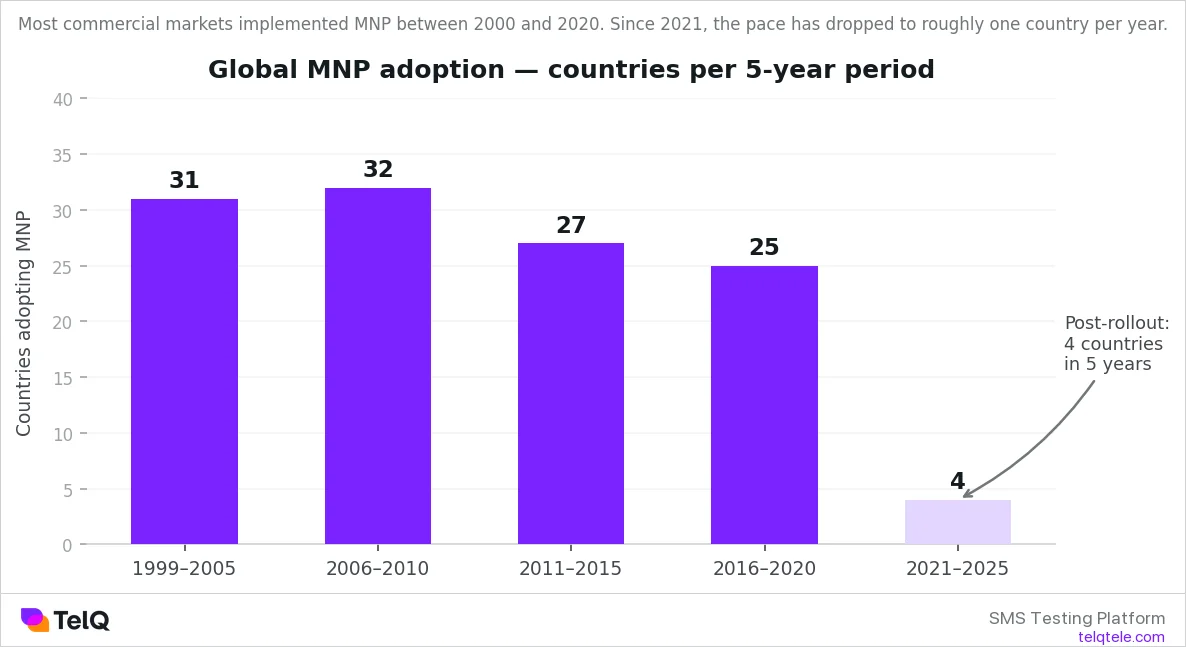
Scroll through the table and the pattern is clear: MNP rollout was primarily a 2000s and 2010s phenomenon. The period from the UK's adoption in 1999 through 2020 accounts for 115 of the 119 countries on this list. Since 2021, just four markets have followed — roughly one per year. The commercial map of MNP is effectively complete.
This shifts the practical question for operators. The challenge is no longer which markets have MNP — it's managing routing in markets where it has been live for a decade or more. Ported numbers accumulate. A number registered on Vodafone may have been ported twice since. If your routing doesn't account for current operator, delivery fails or goes to the wrong carrier. TelQ covers 180+ countries and 1,500+ networks, including ported numbers — so you can test what actually happens when you send to a ported number on a specific network.
So how mobile number portability works? Mobile Number Portability (MNP) allows mobile phone users to switch between service providers while retaining their existing phone numbers. This ensures users don’t have to change numbers when they move to a new telecom operator, improving flexibility and competition among operators.
According to our mobile number portability database, over 119 countries have implemented mobile number portability, allowing users to switch providers without changing their phone numbers. Our interactive map and table provide a detailed breakdown of these countries and the years they launched MNP.
Status as of May 2026. Two countries have official 2026 launch targets: Sri Lanka (August 2026, licensed and platform-ready) and Rwanda (2026, regulatory framework already in force). Curaçao targeted a January 2026 launch but has not yet gone live as of May 2026; no revised date has been confirmed. Several other markets have legal frameworks or active regulatory processes but no firm launch date: Nepal, Uganda, Bhutan, Algeria, Iraq, and Antigua and Barbuda. Papua New Guinea completed a public inquiry in 2025 with a realistic launch window of 2027–2028.
As of 2026, several significant markets have not yet implemented mobile number portability, including Ethiopia, Myanmar, and much of sub-Saharan Africa outside Ghana, Kenya, Nigeria, Senegal, Tanzania, Togo, and Cameroon. For operators sending to these markets, porting is not a routing variable — but it is worth verifying coverage and delivery separately.
For businesses, MNP details help ensure seamless communication with customers, even when they change service providers. It can also prevent potential communication gaps, as numbers remain consistent, reducing the risk of losing contact with important clients.
When a number is ported, messages sent through an SMS route may not be delivered correctly if the sender does not account for the number’s new operator. That’s why it’s crucial to test SMS delivery to ported numbers to ensure proper routing and message accuracy.
TelQ offers an SMS testing tool that helps businesses verify and monitor ported numbers across various countries. Our service ensures that SMS routes are tested and optimized for accurate delivery, even to ported numbers.
TelQ’s test network covers 180+ countries and 1,500+ networks, including ported numbers. When you send a test through your supplier’s route to a TelQ test number, the platform records which SMSC actually handled the message — which tells you whether your routing accounted for the number’s current operator or used the original carrier assignment. See TelQ’s coverage for available test destinations.
We strive to keep our MNP map updated regularly to reflect the latest data on MNP implementation worldwide. You can see the date of the last update right above the map. Please don’t hesitate to contact us if you find any mistakes or if something is not up to date.
© All rights reserved. Made by TelQ Telecom GmbH
We use cookies to improve your experience on our site. By using our site, you consent to cookies.
Manage your cookie preferences below:
Essential cookies enable basic functions and are necessary for the proper function of the website.
CloudFlare provides web performance and security solutions, enhancing site speed and protecting against threats.
Service URL: developers.cloudflare.com (opens in a new window)
These cookies are used for managing login functionality on this website.
Statistics cookies collect information anonymously. This information helps us understand how visitors use our website.
Marketing cookies are used to follow visitors to websites. The intention is to show ads that are relevant and engaging to the individual user.
You can find more information in our Cookie policy and .