

SMS is having a weird moment. Despite being one of the most-used business communication channels on Earth, reports of >90% open rates, growth projections, etc, it's also the channel everyone's slowly learning to ignore. And rightfully so, with research showing that an average American gets at least one spam message every day.
I believe it was Forrest Gump who said "SMS is like a box of chocolates – you bite into one and there's an equal chance you get a smishing message, or an OTP code from your bank"… Or something along those lines.
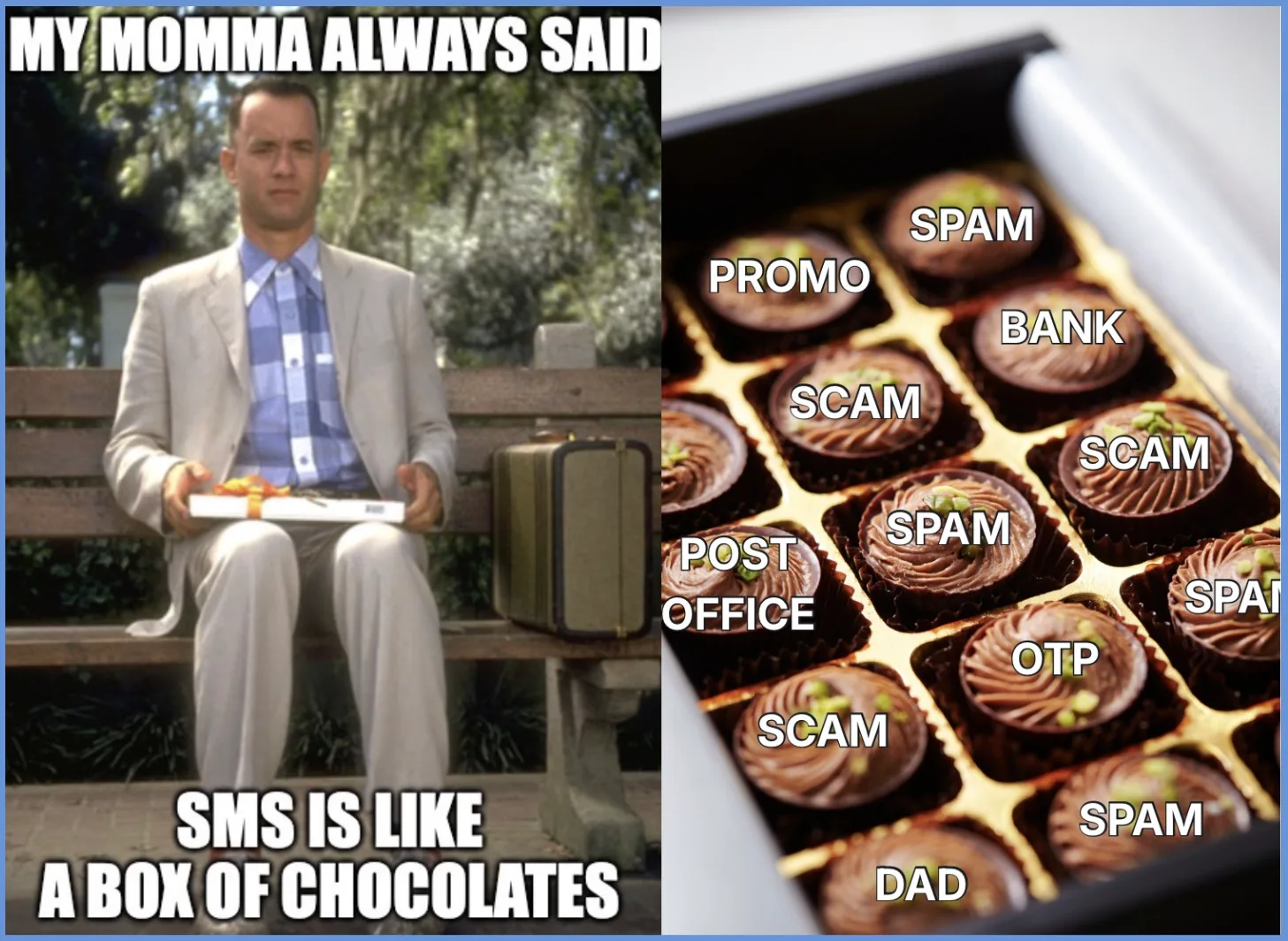
And yet, it doesn't seem like it is going anywhere any time soon. Banks lean on it. Hospitals lean on it. Your local pizza place leans on it. So the big question of 2026 is: How do we make sure businesses continue to lean on SMS?
The Trust Problem, By The Numbers
We need to be real – the numbers don't make for a cheerful read.
Juniper Research warns that the global SMS fraud losses are projected to hit $71 billion in 2026. The CFCA estimated the total telecom revenue lost to fraud at $41.82 billion in 2025 – up from $38.95 billion just two years before.
Even the regulators are headed for the exit. NIST has been politely backing away from recommending SMS for high-security authentication for a while now, and passkeys and authenticator apps are happily eating away at the high-stakes end of the market.
To everyone with a hand in terminating SMS, here's the kicker: consumers don't care about your routing diagram. They care about whether the OTP arrives before the login screen times out, and whether that is actually from DHL or a scam centre. When those two things stop being reliable, the whole channel loses its job.
All this leaves the SMS industry in a precarious position: to prove, every single day, that it can still deliver the boring-but-critical stuff (receipts, reminders, alerts, and codes) faster and more reliably than anyone else. This is not made easy with the current industry landscape. Grey routes, SIM boxes, generated traffic, smishing… every one of these quietly chips away at the idea that the text message you've just received is actually legit.
On Grey Routes
Grey routes are a bit of a grey area here (pun intended). While they can be, and sometimes are, misused, they are a part of the SMS ecosystem for a reason.
For example, some destinations are genuinely hard or expensive to reach through direct connections. Some senders consciously trade a bit of quality for a lower price on non-critical traffic. And ultimately, the line between "clean" and "grey" can shift depending on the operator, the country, or the month you happen to be looking at.
What is harmful here is not knowing your traffic is being routed via a grey route while you're paying for something else. Or worse, routing critical or highly sensitive traffic through what you think is a "direct".
Where SMS Testing Comes in
The main role of an SMS testing tool is to shed the light on the route that's being tested, to show what is actually happening to your or your customers' messages and where they end up. It's not uncommon for vendors to mix and blend routes to sell an alluring cocktail. Some are transparent about it. Some are not.
This is exactly where an SMS testing tool comes into play.
In the past, companies would play it by ear: buy a route, test on their own phones where they can and pray for the best. However, with the recent shift in the industry and the growing need for trust and transparency, such quality assurance tools went from a nice-to-have to the thing that holds the whole house up.
After all, to be able to control and fix something, you must first make it visible. This either happens when testing routes proactively, or when a customer complains and brings an issue to your attention (or worse, silently churns).
Most SMS aggregators nowadays choose the former. Showing clients reliability, transparency and a dedication to a high quality of service goes a long way, and especially in a volatile market.
Some of the questions you'll get answers to when you test your SMS route:
Did the message actually arrive? How long did it take? Did the sender ID survive the trip, or did a route strip it somewhere over the Atlantic? Was the content tampered with? Or was it silently dropped into the void?
For aggregators, testing is how you stay ahead of route changes before they become a delivery problem.
For enterprises, it's how you prove to your CFO that the SMS line item is actually doing its job. And for everyone, it's the difference between talking the talk and walking the walk.
The 2026 Takeaway
One thing became clear in 2026 – the era of "price before quality" has come to an end. Trust in SMS has become crucial for its survival and it needs to get rebuilt, one delivery at a time. And the only way to know you're delivering is to keep testing.
If you're looking for ways to stand out in the SMS industry, quality is the best way to go. Incidentally, quality is a part of our company's name; the capital Q in TelQ. Request a demo with our team. Let's make 2026 a smooth sail.