
Mixed routes have a reputation for being elusive, but in practice they are far less invisible than the people selling them would like you to believe. Mixed aka blended routes are typically a fusion of white (direct/premium) and grey (SIM, SS7) routes. If you're buying a suspiciously cheap direct, high quality or premium route, you might want to take a closer look to see what's underneath.
Every grey route leaves evidence in the traffic it carries, and a proper A2P test is designed specifically to surface that evidence. The logic is straightforward: you send a message to a real number on the destination network, and then compare what arrived against what you had originally sent. Anything that changed along the way is a clue, and most grey routes change quite a lot, making the blended route easier to spot when tested properly.
Put on your detective hat. Let's go Grey Route hunting.
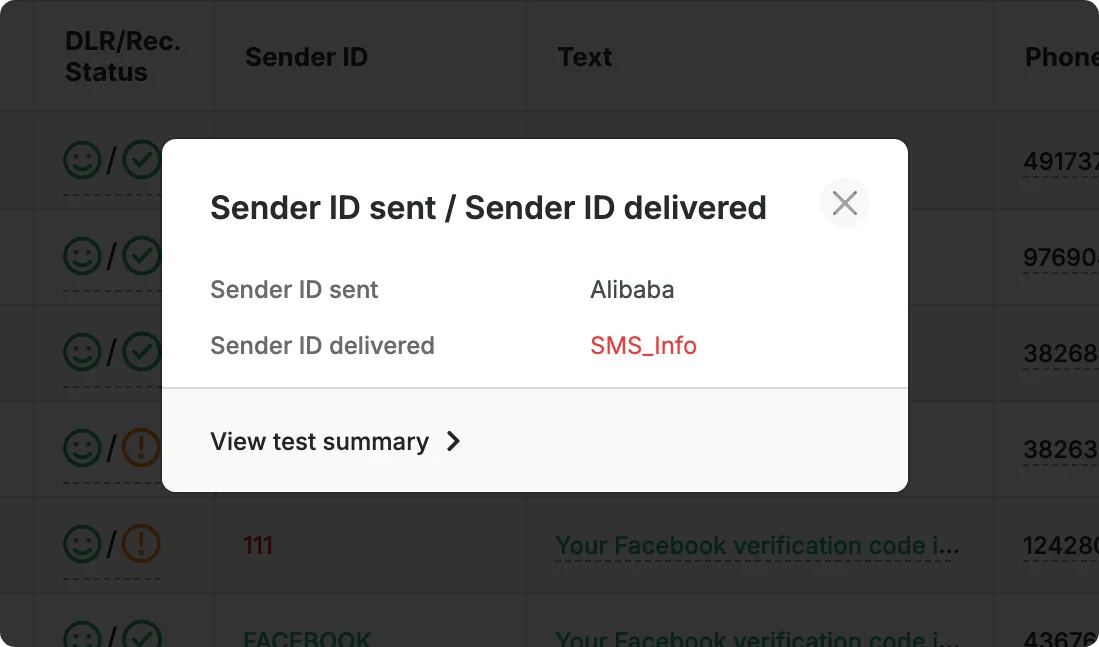
Clue #1 - Sender ID Modification
You send "TECH4U" as the sender ID, but the route delivers "+447xxxxxxxxx", "INFO", or some mangled mess that looks like a cat walked across your keyboard.
Legit A2P routes preserve alphanumeric sender IDs wherever the country's regulations allow it. Grey routes often can't because SIM boxes and P2P bypass routes use real mobile numbers as the source, and real mobile numbers are not designed to impersonate a brand.
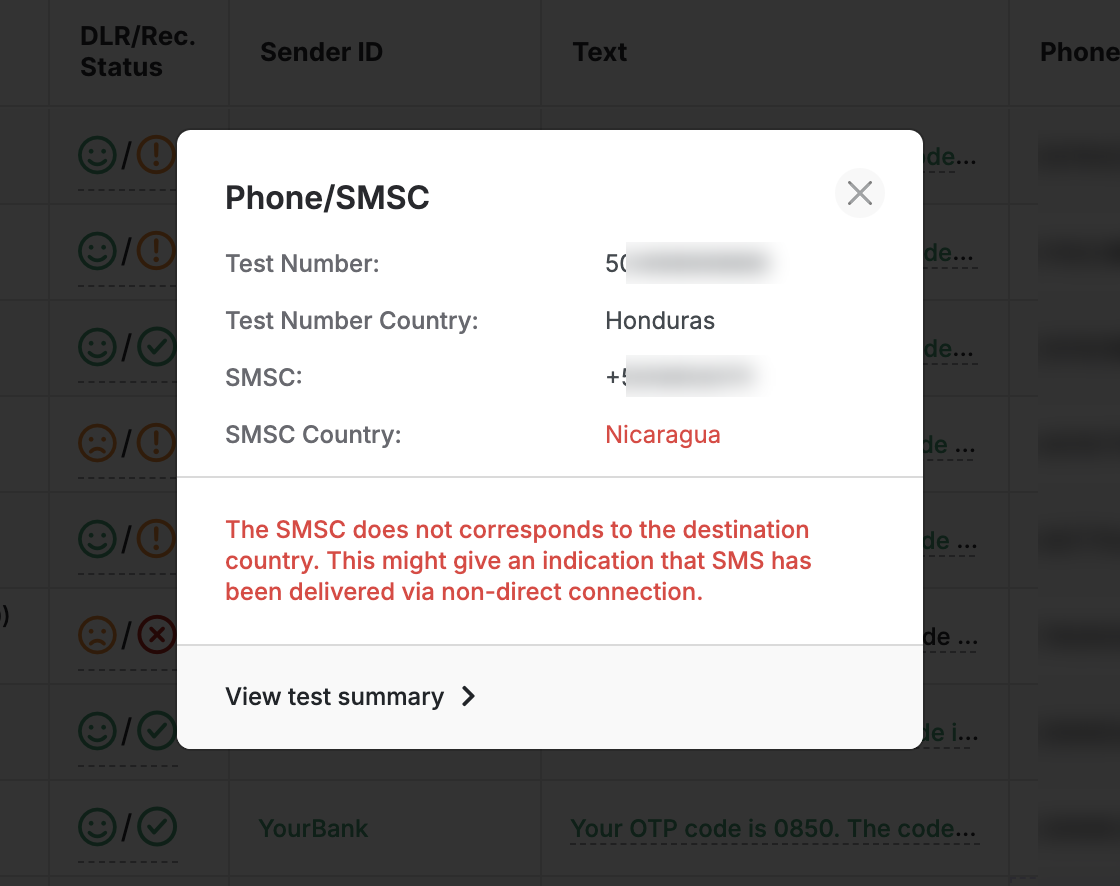
Clue #2 - SMSC Mismatch
If your SMS took a trip across the world, i.e., the test number's country is United Kingdom, but the SMSC is showing Indonesia, the route is, in most cases, not direct.
The address sitting in the message header should match an operator or aggregator that you would reasonably expect to see on that route. If it doesn't, there's a high chance you've got yourself a grey route. TelQ's test results show the SMSC the message actually came from — not what the supplier claimed.
Clue #3 - Content Alteration
Messages that pass through grey routes often arrive looking slightly… wrong.
Special characters disappear, GSM-7 magically transforms to unicode, emojis turn into question marks, links shorten or rewrite themselves, etc.
Any change of such kind means the message passed through something that re-encoded it along the way, and re-encoding is very rarely a feature of a legitimate route.
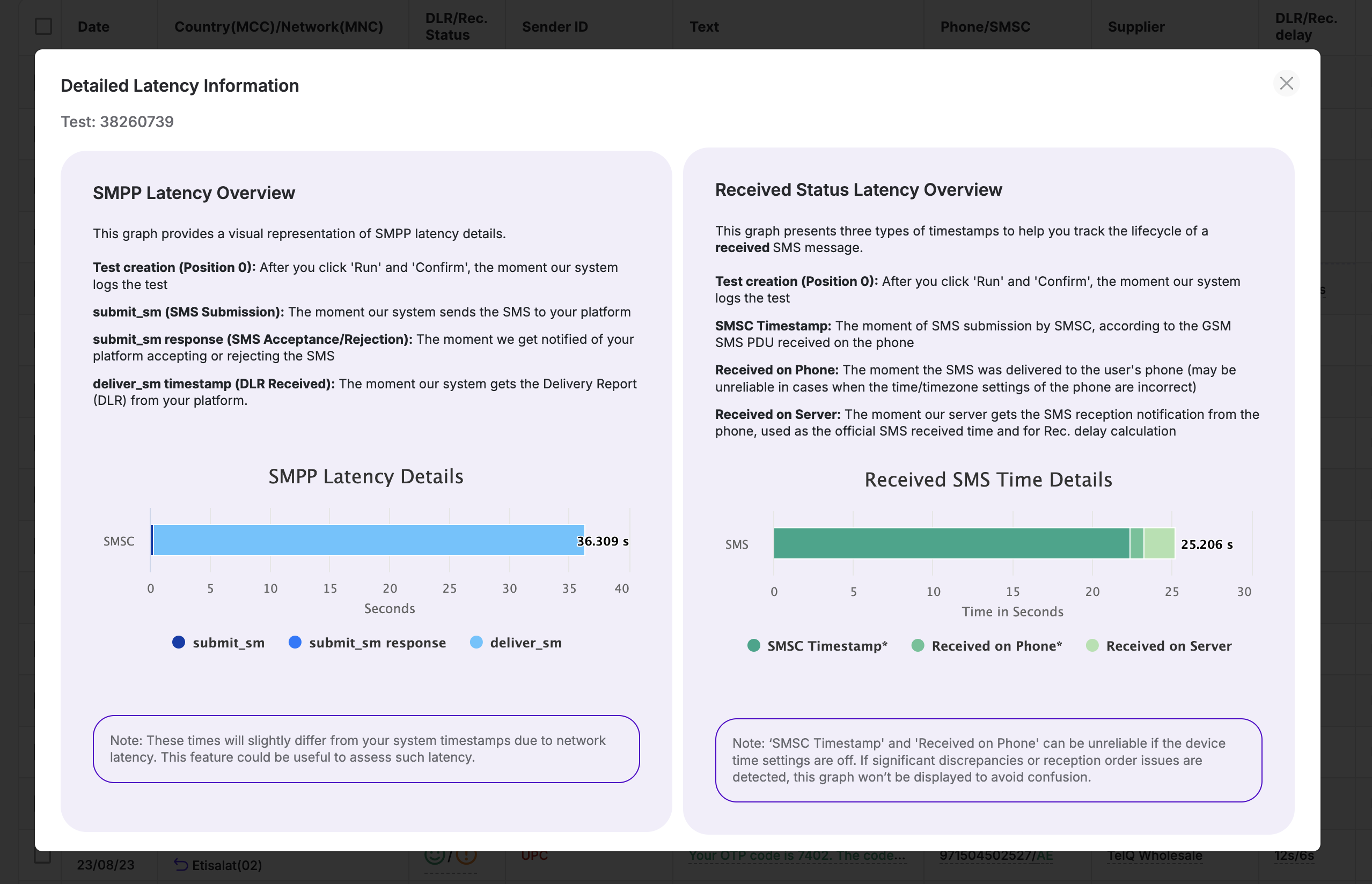
Clue #4 - High Latency
Throttling is another telltale sign your messages are going through a non-direct. In TelQ's test data, a white route typically delivers within five to ten seconds on most destinations; SIM routes (SIM farm grey routes) work a little bit differently.
A2P routes were built for high volume while P2P ones were intended for speed and security. So if you're trying to push out a large batch of messages through a SIM route, you'll notice massive delays. This is a feature, not a bug. The SIM route vendors build in queues and reasonable throughput to limit the number of SMS sent per minute/hour to the SIM cards so as not to burn them fast.
The outcome: an OTP code that arrives 8 minutes late and a very angry customer.
Clue #5 - Inconsistent Delivery Rates Over Time
Grey routes are inherently unstable, because MNOs identify and block them almost as quickly as vendors set them up. This means that delivery rates will look like a rollercoaster on your graphs. A route that delivers at 98% on Monday and drops to 60% by Friday is almost certainly being filtered in real time by the destination network.
One-time tests will never reveal this kind of pattern, which is why scheduled testing across different times and days is where the real value of a testing platform tends to show up.
Clue #6 - Price Too Good to be True
This last point brings us back to the beginning and is the one thing you can actually tell without having done a single SMS test.
If you opt to buy one such too-good-to-be-true route, then you for sure need to test it, and test aggressively before you sign anything. Pricing that dramatic usually exists for a reason — and the other five clues will tell you what it is.
| Clue | What to look for | What it reveals |
|---|---|---|
| Sender ID Modification | Alphanumeric brand name delivered as a number or garbled string | SIM box or P2P bypass — real mobile numbers can't impersonate brands |
| SMSC Mismatch | SMSC country doesn't match the destination network | Undisclosed intermediary; route is not direct |
| Content Alteration | Characters stripped, encoding changed, links rewritten | Message re-encoded in transit — not a feature of legitimate routes |
| High Latency | Delivery taking 30 seconds to several minutes instead of 5–10 | SIM farm queuing; built-in throttle to protect the SIM cards |
| Inconsistent Delivery Rates | 98% Monday, 60% Friday on the same route | MNO filtering in real time; route is being blocked as you send |
| Suspicious Pricing | Price dramatically below market for a "direct" route | Grey component in the blend — the other five clues will confirm it |
The Verdict
While grey routes have a place and a purpose in the telecom industry, undisclosed route blending gives them a bad rep. No one likes pushing out critical traffic via a would-be direct and getting complaints and eroded trust in return. The mistake most providers make is running a single round of tests and assuming the results will apply forever, when in reality such routes shift constantly.
A single clean test on Tuesday morning tells you almost nothing about what will happen on Thursday night and at large volumes. The only testing strategy that genuinely protects your traffic is a continuous one, covering the same routes and destinations at different times of day and different days of the week, so that you catch blended route behaviour while it is happening rather than weeks after it started quietly costing you money.
TelQ's Tests Scheduler runs exactly this kind of continuous monitoring — same routes, same destinations, at randomised intervals — and alerts you when results deviate. If the evidence is there, you'll see it.